


FAQs
In most jurisdictions, purchasing peptides for legitimate scientific research is legal. However, laws vary by country and region. It is the researcher’s responsibility to ensure compliance with all local regulations. We do not sell to individuals for personal use.
We accept major credit cards, bank transfers, and cryptocurrency. Most domestic orders ship within 24–48 hours. International shipping is available to approved research institutions (delivery times vary by country and customs regulations).
Yes. Every batch undergoes independent third-party HPLC and mass spectrometry testing to verify purity (typically ≥98%) and identity. Certificates of Analysis (CoA) are available upon request for every product.
Reconstitution is typically done using bacteriostatic water or sterile water. Gently inject the solvent down the side of the vial and allow it to dissolve slowly. Do not shake vigorously. Refer to the specific peptide’s certificate of analysis or research protocol for recommended concentration.
For maximum stability, lyophilized (freeze-dried) peptides should be stored in a freezer at –20°C or below. Reconstituted peptides should be kept refrigerated (2–8°C) and typically used within 30–60 days. Always protect from light and avoid repeated freeze-thaw cycles.
Research peptides are short chains of amino acids designed for laboratory and scientific investigation. They are used exclusively for in vitro and in vivo research to study biological processes, tissue repair, cellular signaling, and other physiological mechanisms. They are not intended for human or animal consumption.
No. All peptides sold on this website are strictly for research and laboratory use only. They have not been evaluated by the FDA for safety or efficacy in humans. Researchers must comply with all applicable local, state, and federal regulations.
BPC-157 (Body Protection Compound-157) is a synthetic peptide derived from a protective protein found in the human stomach. It is one of the most widely studied research peptides for its potential effects on tissue healing, angiogenesis, gut health, and anti-inflammatory pathways in preclinical models.
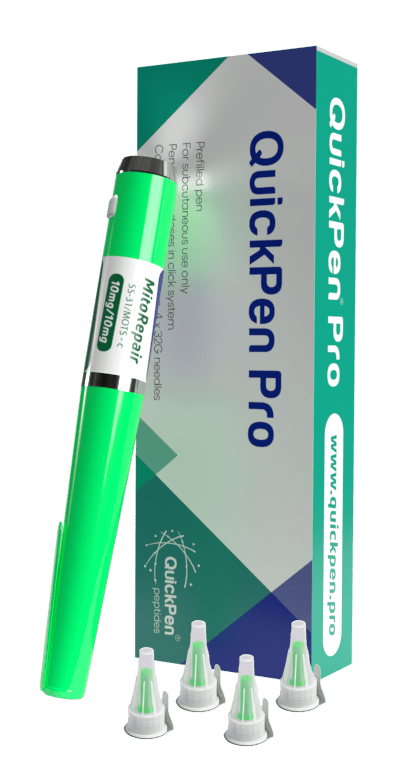
The QuickPen Pro is a ready-to-use, ultra-convenient peptide delivery device designed for precise and consistent research dosing. It combines a high-quality pen injector with pre-measured research peptides for improved accuracy and ease of laboratory application.
Related Peptides
-
CJC-1295 No DAC 10mg
Regular price €90,00 EURRegular price -
MitoRepair Blend SS-31 10mg/MOTS-c 10mg
Regular price €149,00 EURRegular price -
TestoGen 20mg
Regular price €69,00 EURRegular price -
HGH 13.3mg 40IU
Regular price €90,00 EURRegular price


Blog posts
View all-

What Is Ipamorelin? A Research Overview of the ...
A research-focused overview of ipamorelin — its mechanism as a selective GHS-R1a agonist, research applications in GH axis and metabolic studies, and how it compares to other GH secretagogues.
What Is Ipamorelin? A Research Overview of the ...
A research-focused overview of ipamorelin — its mechanism as a selective GHS-R1a agonist, research applications in GH axis and metabolic studies, and how it compares to other GH secretagogues.
-

BPC-157 vs TB-500: What Research Shows About Ti...
A research-focused comparison of BPC-157 and TB-500 — two of the most studied peptides for tissue repair, covering their distinct mechanisms and why they are often investigated together.
BPC-157 vs TB-500: What Research Shows About Ti...
A research-focused comparison of BPC-157 and TB-500 — two of the most studied peptides for tissue repair, covering their distinct mechanisms and why they are often investigated together.
-

GHK-Cu Research: Skin Regeneration, Anti-Aging ...
GHK-Cu is a naturally occurring copper tripeptide complex with one of the broadest research profiles in regenerative biology. Studied for collagen synthesis, wound healing, hair follicle stimulation, antioxidant gene activation,...
GHK-Cu Research: Skin Regeneration, Anti-Aging ...
GHK-Cu is a naturally occurring copper tripeptide complex with one of the broadest research profiles in regenerative biology. Studied for collagen synthesis, wound healing, hair follicle stimulation, antioxidant gene activation,...


