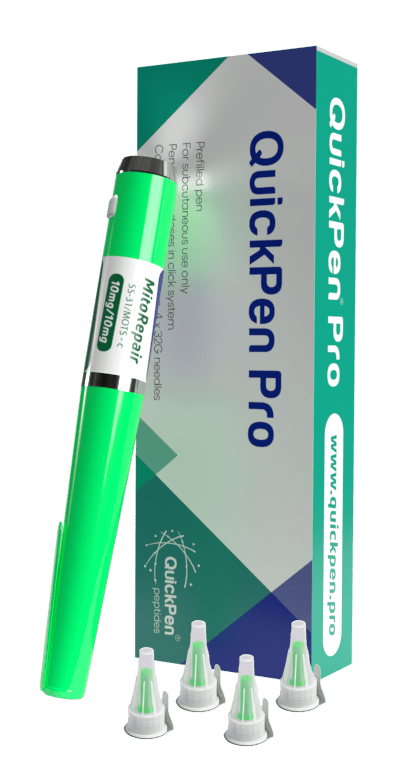
CJC-1295 no DAC is a modified GHRH analog used in research on pulsatile growth hormone release and pituitary signaling.
CJC-1295 without DAC is a tetrasubstituted GHRH analog designed for enhanced receptor affinity and predictable pulsatile GH release. Unlike the DAC version, this form has a shorter half-life and is therefore used in models that require dynamic GH pulse frequency rather than sustained elevation. Researchers frequently explore its impact on IGF-1 regulation, pituitary responsiveness, and hypothalamic-pituitary communication.
Pen Dosage Chart
CJC-1295 No DAC 10mg QuickPen Pro
Volume
3.0 mL
mg/mL
3.33 mg/mL
Click-to-Dose
1 click = 0.033 mg
Example(s)
30 clicks(10 of Pen Scale) = 1 mg
Benefits
Enhances natural pulsatile growth hormone secretion: CJC-1295 (No DAC) amplifies endogenous growth hormone release by directly stimulating the GHRH receptor pathway in the anterior pituitary. Growth hormone is physiologically secreted in discrete pulses, with peak amplitude occurring during deep sleep phases. Rather than producing continuous elevation, CJC-1295 increases the magnitude of these pulses while preserving their rhythmic nature. This pulsatile enhancement is central to maintaining receptor sensitivity and preventing desensitization associated with sustained hormone exposure. The short-acting profile allows GH levels to rise and fall within natural regulatory parameters.
Selective engagement of the GHRH receptor cascade: CJC-1295 (No DAC) binds specifically to the growth hormone–releasing hormone receptor (GHRH-R), a G-protein–coupled receptor expressed on somatotroph cells. Activation of this receptor increases adenylate cyclase activity, elevating intracellular cAMP levels. This rise in cAMP activates protein kinase A, leading to enhanced transcription and exocytosis of growth hormone. Unlike ghrelin-based peptides that act through the GHS-R1a receptor, CJC-1295 does not directly stimulate appetite-related hypothalamic pathways. This receptor specificity differentiates it mechanistically from GHRP compounds.
Preserves hypothalamic somatostatin regulation: The hypothalamus tightly controls GH release through a balance between GHRH stimulation and somatostatin inhibition. Because CJC-1295 stimulates endogenous pathways rather than bypassing them, somatostatin feedback remains active. This allows the body to modulate hormone output dynamically based on physiologic demand. Maintaining this inhibitory counterbalance is important in experimental models examining long-term endocrine stability.
Supports downstream IGF-1–mediated anabolic signaling: Once growth hormone is released, it stimulates hepatic production of insulin-like growth factor 1 (IGF-1). IGF-1 activates intracellular pathways including PI3K/Akt and mTOR, which regulate protein synthesis and cellular growth. Through this two-step endocrine cascade, CJC-1295 indirectly influences tissue adaptation and recovery-related signaling. This layered activation preserves physiological hierarchy rather than directly activating peripheral receptors.
Short-acting profile enables pulse timing studies: Unlike the DAC-modified formulation, the No DAC version lacks albumin-binding extension and therefore has a shorter half-life. This transient activity allows researchers to evaluate timing-dependent endocrine responses and synchronization with circadian cycles. Pulse timing plays a critical role in how tissues respond to growth hormone exposure. By aligning with physiologic rhythms, CJC-1295 (No DAC) supports research focused on hormone pattern optimization rather than continuous stimulation.
Influences sleep-associated growth hormone peaks: Growth hormone secretion is closely linked to slow-wave sleep. Amplifying physiologic GH pulses may enhance the magnitude of nocturnal hormone peaks in experimental models. This connection places CJC-1295 within integrated sleep–endocrine research frameworks. Rather than inducing sleep directly, it operates within hormonal cycles that coincide with restorative phases.
Distinct from ghrelin mimetics and appetite-driven peptides: GHRP compounds stimulate growth hormone release via ghrelin receptor activation and may influence hunger pathways. CJC-1295 operates exclusively through the GHRH receptor pathway, avoiding direct activation of neuropeptide Y–mediated appetite signaling. This distinction makes it more focused on pituitary modulation than hypothalamic hunger circuits. The absence of strong appetite stimulation differentiates its systemic profile.
Facilitates structured endocrine modulation research: Because it enhances natural hormone pulses rather than replacing GH, CJC-1295 supports investigation into physiologic endocrine adaptation. The preservation of feedback loops, receptor sensitivity, and pulse rhythm allows researchers to examine nuanced hormonal modulation. This precision positions the No DAC variant within rhythm-aligned growth hormone research rather than sustained supraphysiologic exposure models.
Integrates within broader neuroendocrine coordination networks: Growth hormone interacts with metabolic regulation, connective tissue remodeling, and circadian timing systems. By amplifying endogenous GH pulses, CJC-1295 participates in this integrated neuroendocrine network. Its activity reflects coordinated communication between hypothalamus, pituitary, and peripheral tissues. This systems-level positioning differentiates it from peptides that act directly at peripheral receptors without upstream regulatory integration.
In most jurisdictions, purchasing peptides for legitimate scientific research is legal. However, laws vary by country and region. It is the researcher’s responsibility to ensure compliance with all local regulations. We do not sell to individuals for personal use.
We accept major credit cards, bank transfers, and cryptocurrency. Most domestic orders ship within 24–48 hours. International shipping is available to approved research institutions (delivery times vary by country and customs regulations).
Yes. Every batch undergoes independent third-party HPLC and mass spectrometry testing to verify purity (typically ≥98%) and identity. Certificates of Analysis (CoA) are available upon request for every product.
Reconstitution is typically done using bacteriostatic water or sterile water. Gently inject the solvent down the side of the vial and allow it to dissolve slowly. Do not shake vigorously. Refer to the specific peptide’s certificate of analysis or research protocol for recommended concentration.
For maximum stability, lyophilized (freeze-dried) peptides should be stored in a freezer at –20°C or below. Reconstituted peptides should be kept refrigerated (2–8°C) and typically used within 30–60 days. Always protect from light and avoid repeated freeze-thaw cycles.
Research peptides are short chains of amino acids designed for laboratory and scientific investigation. They are used exclusively for in vitro and in vivo research to study biological processes, tissue repair, cellular signaling, and other physiological mechanisms. They are not intended for human or animal consumption.
No. All peptides sold on this website are strictly for research and laboratory use only. They have not been evaluated by the FDA for safety or efficacy in humans. Researchers must comply with all applicable local, state, and federal regulations.
BPC-157 (Body Protection Compound-157) is a synthetic peptide derived from a protective protein found in the human stomach. It is one of the most widely studied research peptides for its potential effects on tissue healing, angiogenesis, gut health, and anti-inflammatory pathways in preclinical models.
The QuickPen Pro is a ready-to-use, ultra-convenient peptide delivery device designed for precise and consistent research dosing. It combines a high-quality pen injector with pre-measured research peptides for improved accuracy and ease of laboratory application.
A research-focused overview of ipamorelin — its mechanism as a selective GHS-R1a agonist, research applications in GH axis and metabolic studies, and how it compares to other GH secretagogues.
A research-focused comparison of BPC-157 and TB-500 — two of the most studied peptides for tissue repair, covering their distinct mechanisms and why they are often investigated together.
GHK-Cu is a naturally occurring copper tripeptide complex with one of the broadest research profiles in regenerative biology. Studied for collagen synthesis, wound healing, hair follicle stimulation, antioxidant gene activation,...