PT-141 (Bremelanotide) is a synthetic melanocortin receptor agonist studied for its role in sexual arousal and central libido signaling. Unlike PDE-5 inhibitors, it acts directly on the central nervous system via melanocortin pathways. In clinical research, it has been observed to increase sexual desire scores in both male and female populations. Administered subcutaneously, PT-141 supports hypothalamic activation and neurotransmitter modulation in controlled research settings.
Pen Dosage Chart
PT-141 (Bremelanotide) 10 mg QuickPen Pro
Volume
3.0 mL
mg/mL
3.33 mg/mL
Click-to-Dose
1 click = 0.033 mg
Example(s)
30 clicks(10 of Pen Scale) = 1 mg
PT-141 (Bremelanotide) is a synthetic melanocortin receptor agonist derived from alpha-MSH analog research. It belongs to the class of neuroactive peptide hormones targeting melanocortin receptors, particularly MC4R and MC3R. PT-141 is primarily studied in domains such as sexual function research, central arousal signaling, and hypothalamic neurobiology. Unlike peripheral vasodilators, its mechanism is centrally mediated within the brain.
Our formulation is provided in a stabilized pre-mixed injection pen for SubQ administration. Subcutaneous delivery supports reliable systemic exposure and consistent CNS signaling activation in research protocols. Each unit is freshly prepared to maintain peptide integrity and standardized dosing. This format eliminates multi-step vial preparation and simplifies laboratory handling. The product is formulated strictly for research use only.
In clinical and preclinical studies, PT-141 has been shown to activate melanocortin receptors in the hypothalamus → ↑ dopaminergic signaling and ↑ sexual motivation pathways. Research indicates modulation of limbic system activity associated with arousal and desire. Unlike PDE-5 inhibitors, PT-141 does not primarily act on nitric oxide-mediated vasodilation.
Mechanism of Action
PT-141 activates melanocortin receptors in the central nervous system, particularly MC4R receptors within the hypothalamus. Activation of these receptors influences dopamine release → ↑ sexual motivation and arousal signaling. Unlike PDE-5 inhibitors, PT-141 does not depend primarily on peripheral blood flow modulation. Instead, it acts upstream at the level of neural desire circuits. This central mechanism differentiates it from vasodilatory erectile function agents.
Benefits
Central Activation Of Sexual Motivation Circuits: PT-141 has been studied for its ability to activate melanocortin receptors within hypothalamic nuclei associated with sexual motivation and arousal behavior. Unlike peripheral vasodilators, this peptide acts directly on central neural circuits governing desire. Clinical trials demonstrate ↑ sexual desire scores and ↑ frequency of satisfying sexual events in controlled populations. Neuroimaging and behavioral research suggest involvement of limbic structures linked to reward anticipation. Activation of melanocortin signaling → ↑ dopaminergic transmission in mesolimbic pathways. This central mechanism positions PT-141 as a neuroendocrine modulator rather than a vascular agent. Evidence type: Human RCT ✔ | Observational ✔.
Selective MC4R And MC3R Receptor Agonism: PT-141 selectively binds melanocortin-4 receptors (MC4R) and melanocortin-3 receptors (MC3R) expressed in hypothalamic and limbic regions. MC4R activation triggers adenylate cyclase → ↑ cAMP production → modulation of downstream dopamine signaling. Preclinical models confirm behavioral changes associated with receptor stimulation. This receptor-level specificity differentiates PT-141 from hormonal therapies that broadly alter endocrine balance. Research also indicates interaction with pro-opiomelanocortin (POMC) neurons → modulation of motivational circuitry. These receptor interactions underpin its central arousal profile.
Dopaminergic Reward Circuit Enhancement: Melanocortin receptor activation influences mesolimbic dopamine pathways projecting from the ventral tegmental area to the nucleus accumbens. PT-141 administration has been associated with ↑ dopaminergic activity in reward-processing regions in animal models. Dopamine plays a central role in sexual motivation and anticipatory behavior. This pathway differs fundamentally from nitric oxide-mediated smooth muscle relaxation. By acting upstream in motivational circuitry, PT-141 influences desire rather than only physiological response.
Independence From Nitric Oxide Vasodilation: Unlike PDE-5 inhibitors such as sildenafil, PT-141 does not primarily increase nitric oxide production or inhibit phosphodiesterase enzymes. Its mechanism does not rely on peripheral vasodilation of penile smooth muscle. Instead, central melanocortin activation → ↑ neural arousal signaling, which may secondarily influence physiological response. This distinction allows evaluation in populations where vascular function is not the primary limiting factor. Research highlights mechanistic divergence from traditional erectile function compounds.
Female Sexual Desire Research And Regulatory Validation: Clinical studies in female populations with hypoactive sexual desire research diagnoses demonstrate measurable improvements in desire-related endpoints. Phase trials report statistically significant ↑ sexual desire scores compared to placebo. These effects are centrally mediated and not dependent on hormonal replacement mechanisms. Regulatory approval in certain jurisdictions reflects controlled human data supporting this pathway. Evidence type: Human RCT ✔.
Male Arousal Signaling And Behavioral Response Models: In male research populations, PT-141 has been associated with enhanced erectile response secondary to central activation. Preclinical studies show ↑ mounting behavior and ↑ copulatory motivation in animal models. These behavioral changes occur independently of direct smooth muscle relaxation mechanisms. Central dopaminergic activation is considered the primary driver of these effects. Evidence type: Human studies ✔ | Animal ▣.
POMC Neuron Activation And Melanocortin System Engagement: PT-141 activates pro-opiomelanocortin (POMC) neurons within the arcuate nucleus of the hypothalamus. POMC activation → release of melanocortin peptides influencing motivational and reward circuits. This engagement extends beyond sexual signaling and interacts with broader appetite and reward biology pathways. The melanocortin system plays a key role in behavioral drive regulation. This systems-level activation distinguishes PT-141 from peripheral-only agents.
Neuroendocrine Integration Without Direct Testosterone Modulation: PT-141 does not directly increase testosterone production or replace androgen pathways. Its effects occur independently of gonadal hormone elevation. This allows central arousal signaling without broad endocrine disruption. Clinical endocrine panels demonstrate minimal direct hormonal alteration under therapeutic dosing in research settings. The mechanism remains neurocentric rather than systemic hormonal.
Predictable Subcutaneous Pharmacokinetics: Provided in a stabilized pre-mixed injection pen for SubQ administration, PT-141 demonstrates reliable systemic absorption in clinical research. Subcutaneous delivery supports controlled plasma concentration curves and predictable onset windows in human trials. This route allows rapid engagement of central melanocortin pathways. Each unit is prepared fresh and intended strictly for research use only.
In most jurisdictions, purchasing peptides for legitimate scientific research is legal. However, laws vary by country and region. It is the researcher’s responsibility to ensure compliance with all local regulations. We do not sell to individuals for personal use.
We accept major credit cards, bank transfers, and cryptocurrency. Most domestic orders ship within 24–48 hours. International shipping is available to approved research institutions (delivery times vary by country and customs regulations).
Yes. Every batch undergoes independent third-party HPLC and mass spectrometry testing to verify purity (typically ≥98%) and identity. Certificates of Analysis (CoA) are available upon request for every product.
Reconstitution is typically done using bacteriostatic water or sterile water. Gently inject the solvent down the side of the vial and allow it to dissolve slowly. Do not shake vigorously. Refer to the specific peptide’s certificate of analysis or research protocol for recommended concentration.
For maximum stability, lyophilized (freeze-dried) peptides should be stored in a freezer at –20°C or below. Reconstituted peptides should be kept refrigerated (2–8°C) and typically used within 30–60 days. Always protect from light and avoid repeated freeze-thaw cycles.
Research peptides are short chains of amino acids designed for laboratory and scientific investigation. They are used exclusively for in vitro and in vivo research to study biological processes, tissue repair, cellular signaling, and other physiological mechanisms. They are not intended for human or animal consumption.
No. All peptides sold on this website are strictly for research and laboratory use only. They have not been evaluated by the FDA for safety or efficacy in humans. Researchers must comply with all applicable local, state, and federal regulations.
BPC-157 (Body Protection Compound-157) is a synthetic peptide derived from a protective protein found in the human stomach. It is one of the most widely studied research peptides for its potential effects on tissue healing, angiogenesis, gut health, and anti-inflammatory pathways in preclinical models.
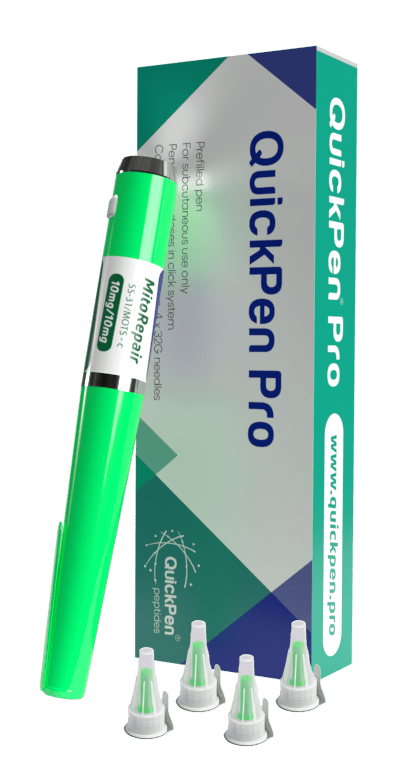
The QuickPen Pro is a ready-to-use, ultra-convenient peptide delivery device designed for precise and consistent research dosing. It combines a high-quality pen injector with pre-measured research peptides for improved accuracy and ease of laboratory application.
A research-focused overview of ipamorelin — its mechanism as a selective GHS-R1a agonist, research applications in GH axis and metabolic studies, and how it compares to other GH secretagogues.
A research-focused comparison of BPC-157 and TB-500 — two of the most studied peptides for tissue repair, covering their distinct mechanisms and why they are often investigated together.
GHK-Cu is a naturally occurring copper tripeptide complex with one of the broadest research profiles in regenerative biology. Studied for collagen synthesis, wound healing, hair follicle stimulation, antioxidant gene activation,...