Skip to product information
1 of 2

Quickpen Pro Peptides

LL-37 5mg

LL-37 5mg

Regular price €60,00 EUR
Regular price Sale price €60,00 EUR
Sale Sold out
Taxes included. Shipping calculated at checkout.
Quantity

LL-37 is a naturally occurring antimicrobial peptide derived from the human cathelicidin family and studied for its role in innate immune defense and inflammatory signaling modulation. It exhibits broad-spectrum antimicrobial activity and influences immune cell recruitment and cytokine expression. In research settings, LL-37 has been observed to support host defense pathways, tissue repair processes, and barrier integrity signaling. Formulated in a stabilized pre-mixed injection pen for research use only.

Pen Dosage Chart

LL-37 5mg QuickPen Pro
Volume 3.0 mL
mg/mL 1.66 mg/mL
Click-to-Dose 1 click = 0.0166 mg
Example(s) 30 clicks(10 of Pen Scale) = 0.5 mg


Mechanism of Action

LL-37 supports innate immune defense by directly interacting with microbial membranes and modulating host immune signaling pathways. It disrupts pathogen membranes while also influencing cytokine release and immune cell recruitment. This dual antimicrobial and immunomodulatory profile distinguishes LL-37 within host defense research.

Benefits

  • Broad-spectrum antimicrobial membrane destabilization:
    LL-37 is a cationic amphipathic peptide that preferentially binds negatively charged phospholipids present on microbial membranes. Through electrostatic attraction and hydrophobic insertion, it disrupts membrane integrity and induces structural destabilization. This mechanism results in rapid membrane permeability changes rather than inhibition of intracellular enzymatic pathways. Because its activity is membrane-targeted, it does not rely on specific metabolic targets that commonly mutate in antibiotic resistance models. In vitro systems demonstrate disruption of Gram-positive and Gram-negative bacterial membranes as well as certain viral envelopes. This structural mode of action positions LL-37 as a host-defense peptide rather than a classical antimicrobial compound.
  • Integration within innate immune signaling networks:
    Beyond direct pathogen interaction, LL-37 functions as an immunomodulatory mediator. It interacts with toll-like receptor pathways and modulates downstream NF-kB signaling cascades. This influence alters cytokine and chemokine expression patterns in epithelial and immune cells. LL-37 does not act as a simple immune stimulant but rather fine-tunes inflammatory signaling intensity depending on environmental context. This regulatory capability supports coordinated innate immune activation rather than excessive inflammatory amplification.
  • Chemotactic recruitment of immune effector cells:
    LL-37 participates in chemotactic signaling processes that attract neutrophils, monocytes, dendritic cells, and T lymphocytes to sites of microbial exposure. Experimental models show increased migration of immune cells toward LL-37 concentration gradients. This recruitment facilitates early containment of pathogens before adaptive immunity becomes dominant. Its role in shaping immune cell trafficking dynamics highlights its importance in early-phase host defense biology.
  • Modulation of epithelial barrier defense mechanisms:
    LL-37 is expressed in skin, respiratory epithelium, and gastrointestinal mucosa, where it contributes to surface-level microbial regulation. It influences tight junction integrity and epithelial cell proliferation in laboratory models. These effects support structural barrier resilience against microbial invasion. By integrating antimicrobial action with barrier maintenance, LL-37 serves as a multifunctional component of first-line defense systems.
  • Angiogenic and tissue repair signaling involvement:
    Research indicates that LL-37 influences endothelial cell migration and angiogenic signaling pathways. It has been associated with vascular endothelial growth factor modulation in experimental systems. These effects contribute to organized tissue repair responses following injury. The peptide’s involvement in both immune defense and regenerative processes reflects its dual functional role within host physiology.
  • Context-dependent regulation of inflammatory cascades:
    LL-37 demonstrates the capacity to either enhance or suppress inflammatory mediator expression depending on cellular environment. In certain models, it reduces excessive pro-inflammatory cytokine production, while in others it enhances targeted immune activation. This context-dependent modulation suggests a role in immune calibration rather than linear stimulation. Such flexibility is central to its positioning within immune balance research domains.
  • Interaction with microbial biofilm dynamics:
    Biofilms represent structured microbial communities resistant to conventional antimicrobial therapies. LL-37 has been evaluated for its ability to interfere with biofilm formation and structural integrity in experimental systems. Membrane disruption and interference with microbial communication pathways contribute to this activity. These findings extend its research relevance into antimicrobial resistance and chronic infection models.
  • Host-pathogen interface signaling integration:
    LL-37 operates at the interface between host tissue and microbial exposure. It integrates membrane-level antimicrobial action with intracellular immune signaling modulation. This dual functionality allows coordinated responses involving pathogen clearance, immune recruitment, and tissue remodeling. Its evolutionary conservation within the cathelicidin family underscores its central role in innate host defense biology.
  • Controlled subcutaneous delivery for structured immune research:
    Provided in a stabilized pre-mixed injection pen for SubQ administration, LL-37 supports predictable systemic exposure in experimental protocols. Subcutaneous delivery allows structured dosing parameters and reproducible immune engagement conditions. Each unit is freshly prepared and intended strictly for laboratory use only.
View full details

FAQs

In most jurisdictions, purchasing peptides for legitimate scientific research is legal. However, laws vary by country and region. It is the researcher’s responsibility to ensure compliance with all local regulations. We do not sell to individuals for personal use.

We accept major credit cards, bank transfers, and cryptocurrency. Most domestic orders ship within 24–48 hours. International shipping is available to approved research institutions (delivery times vary by country and customs regulations).

Yes. Every batch undergoes independent third-party HPLC and mass spectrometry testing to verify purity (typically ≥98%) and identity. Certificates of Analysis (CoA) are available upon request for every product.

Reconstitution is typically done using bacteriostatic water or sterile water. Gently inject the solvent down the side of the vial and allow it to dissolve slowly. Do not shake vigorously. Refer to the specific peptide’s certificate of analysis or research protocol for recommended concentration.

For maximum stability, lyophilized (freeze-dried) peptides should be stored in a freezer at –20°C or below. Reconstituted peptides should be kept refrigerated (2–8°C) and typically used within 30–60 days. Always protect from light and avoid repeated freeze-thaw cycles.

Research peptides are short chains of amino acids designed for laboratory and scientific investigation. They are used exclusively for in vitro and in vivo research to study biological processes, tissue repair, cellular signaling, and other physiological mechanisms. They are not intended for human or animal consumption.

No. All peptides sold on this website are strictly for research and laboratory use only. They have not been evaluated by the FDA for safety or efficacy in humans. Researchers must comply with all applicable local, state, and federal regulations.

BPC-157 (Body Protection Compound-157) is a synthetic peptide derived from a protective protein found in the human stomach. It is one of the most widely studied research peptides for its potential effects on tissue healing, angiogenesis, gut health, and anti-inflammatory pathways in preclinical models.

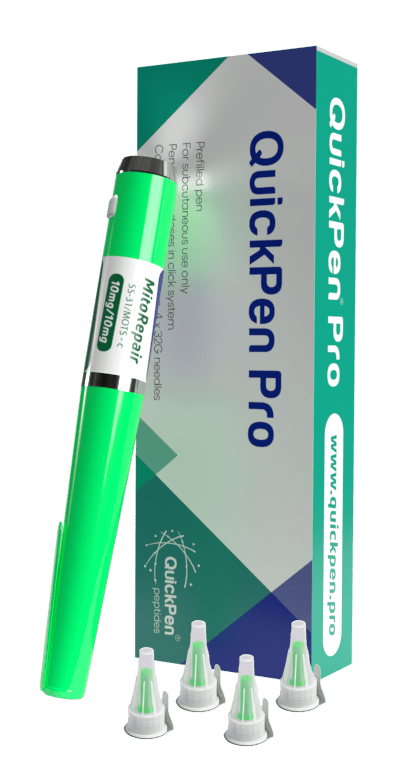
The QuickPen Pro is a ready-to-use, ultra-convenient peptide delivery device designed for precise and consistent research dosing. It combines a high-quality pen injector with pre-measured research peptides for improved accuracy and ease of laboratory application.