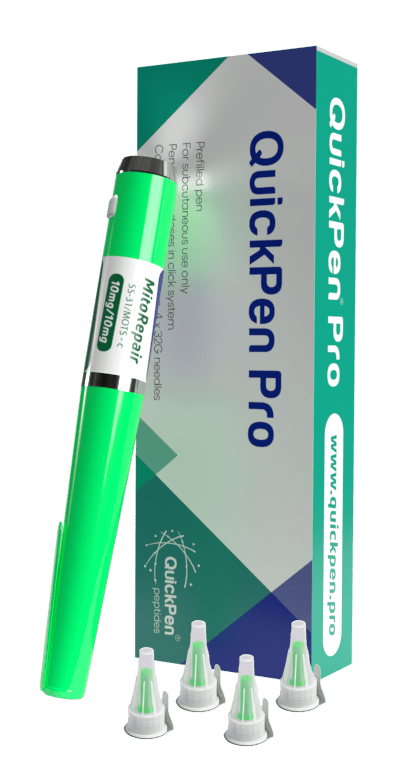
GHK-Cu is a naturally occurring copper-binding peptide used in regenerative, anti-inflammatory, and cellular signaling research.
GHK-Cu is a tripeptide complex consisting of Gly-His-Lys chelated with copper(II). Research commonly explores its role in tissue remodeling, gene expression modulation, wound environments, and anti-inflammatory signaling. GHK-Cu has also demonstrated regulatory effects on metalloproteinases, fibroblast activity, and oxidative stress pathways. Due to its metal-binding properties, it is heavily utilized in studies involving cellular regeneration and extracellular matrix biology.
Pen Dosage Chart
GHK-Cu Skin Glow 100mg QuickPen Pro
Volume
3.0 mL
mg/mL
33.3 mg/mL
Click-to-Dose
1 click = 0.33 mg
Example(s)
30 clicks(10 of Pen Scale) = 10 mg
GHK-Cu has been studied for its effects on oxidative stress markers. Research reports that the peptide increases superoxide dismutase activity and reduces lipid peroxidation in experimental models. The copper ion within the GHK-Cu complex participates in superoxide dismutase mimetic activity, and gene expression data shows upregulation of several antioxidant-related genes following GHK-Cu treatment in cell culture systems.
Benefits
Promotion of Collagen and Elastin Synthesis: GHK-Cu is extensively studied for its ability to stimulate collagen and elastin production in skin fibroblasts. This effect improves dermal structure, elasticity, and firmness, contributing to more youthful and resilient tissue architecture. In research models, increased expression of extracellular matrix proteins has been observed, supporting its use in studies of wound healing and skin regeneration.
Acceleration of Wound Healing: GHK-Cu promotes faster wound closure and epithelial repair by stimulating keratinocyte migration, angiogenesis, and fibroblast proliferation. It also enhances the synthesis of glycosaminoglycans and decorin, key molecules for tissue matrix integrity. These effects make it a strong candidate in regenerative research involving burns, ulcers, and post-surgical recovery.
Powerful Anti-Inflammatory and Antioxidant Actions: Research shows that GHK-Cu reduces inflammatory cytokines such as IL-6 and TNF-α while enhancing antioxidant enzyme expression, including superoxide dismutase and catalase. This combination helps protect tissues from oxidative stress, cellular aging, and inflammatory degradation, contributing to overall cellular health and regeneration.
Stimulation of Angiogenesis and Tissue Remodeling: GHK-Cu has been observed to promote new capillary formation and improve oxygen and nutrient delivery to damaged tissue. This pro-angiogenic activity accelerates remodeling and supports long-term regeneration of skin, muscle, and connective tissue structures in experimental models.
Activation of Stem Cell Pathways: In vitro research suggests that GHK-Cu activates stem cell-related gene expression and supports progenitor cell differentiation in tissue repair processes. This gene modulation effect extends to pathways related to wound response, growth factors, and anti-fibrotic mechanisms, making it of growing interest in regenerative biology studies.
Improvement of Skin Texture and Tone: Clinical and preclinical data indicate that GHK-Cu can reduce fine lines, wrinkles, and skin roughness through enhanced collagen matrix formation and hydration. This peptide’s effect on dermal density and surface morphology positions it as a benchmark compound in cosmetic and dermatological research formulations.
Regulation of Hair Growth and Follicle Health: GHK-Cu has been observed to stimulate hair follicle activity and prolong the anagen (growth) phase. It improves blood supply and reduces follicular inflammation, supporting experimental models aimed at reversing hair thinning or promoting scalp regeneration. Its copper-binding capacity contributes to enzymatic balance critical for follicular metabolism.
Protection Against Oxidative and Cellular Aging: GHK-Cu exerts cytoprotective effects by chelating free copper ions and reducing oxidative damage to lipids, proteins, and DNA. These antioxidant properties are associated with enhanced mitochondrial function and longevity-related gene expression, supporting research into anti-aging and cellular resilience mechanisms.
Anti-Fibrotic and Tissue Remodeling Properties: Research has shown that GHK-Cu reduces fibrosis in liver, lung, and skin models by downregulating TGF-β1 and other pro-fibrotic genes. This promotes more balanced tissue remodeling and prevents excessive scar formation, contributing to smoother recovery and improved functional outcomes in regeneration research.
Synergistic Effects in Regenerative Blends: When combined with peptides such as BPC-157 or TB-500, GHK-Cu enhances tissue repair through complementary mechanisms—angiogenesis, fibroblast stimulation, and collagen synthesis. This synergy forms the basis of advanced regenerative research blends focused on recovery, skin health, and post-injury repair.
Gene Expression Resetting and Cellular Rejuvenation: Transcriptomic analyses reveal that GHK-Cu can revert gene expression profiles of aged cells to a more youthful state, affecting over 4,000 genes linked to cell growth, antioxidant defense, and repair. This profound genomic modulation underscores its growing significance in anti-aging, epigenetic, and longevity research models.
In most jurisdictions, purchasing peptides for legitimate scientific research is legal. However, laws vary by country and region. It is the researcher’s responsibility to ensure compliance with all local regulations. We do not sell to individuals for personal use.
We accept major credit cards, bank transfers, and cryptocurrency. Most domestic orders ship within 24–48 hours. International shipping is available to approved research institutions (delivery times vary by country and customs regulations).
Yes. Every batch undergoes independent third-party HPLC and mass spectrometry testing to verify purity (typically ≥98%) and identity. Certificates of Analysis (CoA) are available upon request for every product.
Reconstitution is typically done using bacteriostatic water or sterile water. Gently inject the solvent down the side of the vial and allow it to dissolve slowly. Do not shake vigorously. Refer to the specific peptide’s certificate of analysis or research protocol for recommended concentration.
For maximum stability, lyophilized (freeze-dried) peptides should be stored in a freezer at –20°C or below. Reconstituted peptides should be kept refrigerated (2–8°C) and typically used within 30–60 days. Always protect from light and avoid repeated freeze-thaw cycles.
Research peptides are short chains of amino acids designed for laboratory and scientific investigation. They are used exclusively for in vitro and in vivo research to study biological processes, tissue repair, cellular signaling, and other physiological mechanisms. They are not intended for human or animal consumption.
No. All peptides sold on this website are strictly for research and laboratory use only. They have not been evaluated by the FDA for safety or efficacy in humans. Researchers must comply with all applicable local, state, and federal regulations.
BPC-157 (Body Protection Compound-157) is a synthetic peptide derived from a protective protein found in the human stomach. It is one of the most widely studied research peptides for its potential effects on tissue healing, angiogenesis, gut health, and anti-inflammatory pathways in preclinical models.
The QuickPen Pro is a ready-to-use, ultra-convenient peptide delivery device designed for precise and consistent research dosing. It combines a high-quality pen injector with pre-measured research peptides for improved accuracy and ease of laboratory application.
A research-focused overview of ipamorelin — its mechanism as a selective GHS-R1a agonist, research applications in GH axis and metabolic studies, and how it compares to other GH secretagogues.
A research-focused comparison of BPC-157 and TB-500 — two of the most studied peptides for tissue repair, covering their distinct mechanisms and why they are often investigated together.
GHK-Cu is a naturally occurring copper tripeptide complex with one of the broadest research profiles in regenerative biology. Studied for collagen synthesis, wound healing, hair follicle stimulation, antioxidant gene activation,...